Scholarship 1 Scholarship 2 Scholarship 3
UPTO 100% SCHOLARSHIPSAPPLY BY 02 JULY 2026
00
DAYS
00
HRS
00
MIN
00
SEC

Innovative Practices

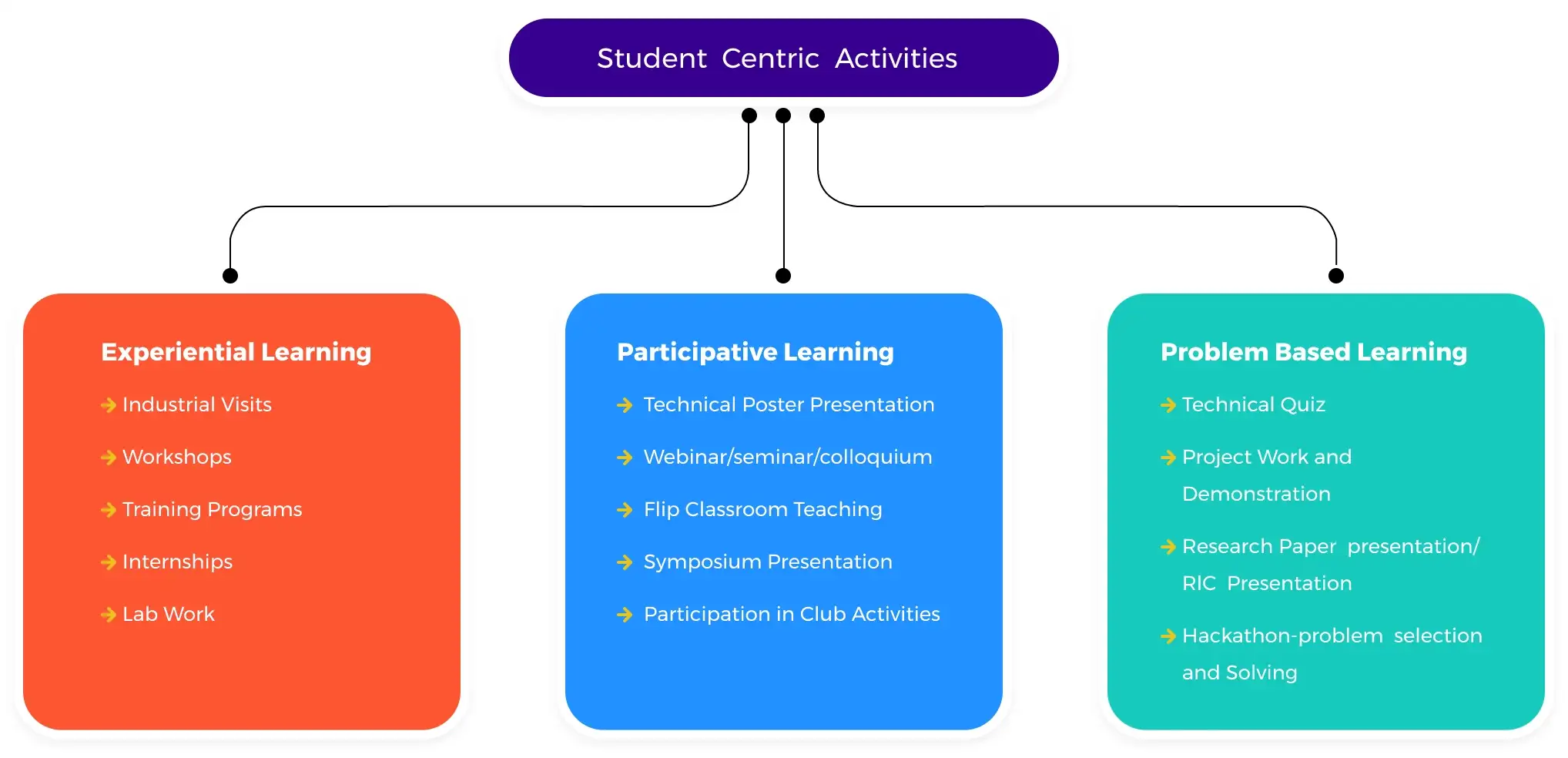
Innovative practices refer to the implementation of novel strategies, methods, and approaches that enhance teaching-learning, research, administration, and community engagement within an academic institution. These practices aim to promote creativity, critical thinking, interdisciplinary collaboration, and technological advancement, ultimately leading to improved academic outcomes and institutional excellence. The purpose of introducing these new teaching strategies and methods is to improve academic outcomes and address real problems to promote equitable learning. Some of the student centric activities are shown below:
Innovative-Practices
The Department of Electronics and Communication Engineering has implemented several innovative initiatives in teaching–learning, assessment, and skill development to enhance student learning outcomes.
our-impact-banner

Virtual, Augmented and Simulation-based Learning (VAC)

The Department effectively utilizes virtual labs, simulation tools, and augmented learning platforms to enhance conceptual understanding. Tools such as MATLAB, Simulink, Multisim, Cadence, Xilinx, and NI LabVIEW are integrated into coursework.

Students perform virtual experiments and simulations related to:

  • Analog and Digital Circuits
  • Communication Systems
  • VLSI Design
  • Signal Processing
  • Embedded and IoT Systems

These immersive learning experiences help students visualize complex ECE concepts and safely experiment with system-level designs before hardware implementation.

Active Learning Approaches

The Department has shifted from traditional lecture-based teaching to active learning methodologies, including:

  • Think–Pair–Share activities
  • Case studies on real communication systems
  • Design-based problem solving
  • Concept mapping and peer instruction

These approaches promote critical thinking, analytical ability, and conceptual clarity in core ECE subjects.

our-impact-banner
our-impact-banner

Project-Based Learning (PBL)

Project-Based Learning is a key innovative practice in the Department. Students undertake mini projects addressing real-world problems in areas such as:

  • Digital Electronics1. Jyoti Verma, Pratima Manhas, Neerja Negi, 2025, “Novel Method for Image Steganography Utilizing the Blend of LSB and 1. Jyoti Verma, Pratima Manhas, Neerja Negi, 2025, “Novel Method for Image Steganography Utilizing the Blend of LSB and MSB”, 2nd International Conference on Recent Developments in Cyber Security, ReDCySec 2024”2025. DOI:10.1007/978-981-96-3284-8_11
  • MSB”, 2nd International Conference on Recent Developments in Cyber Security, ReDCySec 2024”2025. DOI:10.1007/978-981-96-3284-8_11
  • VLSI Design
  • Embedded systems
  • Analog Electronics

This approach enhances technical competence, innovation, teamwork, and communication skills, preparing students for industry and research careers.

Flipped Classroom Model

The Department implements the flipped classroom model in selected courses. Students access pre-recorded lectures, reading materials, and tutorials before class. Classroom time is used for:

  • Problem-solving
  • Design discussions
  • Circuit analysis
  • Hands-on simulations

This model improves student engagement, self-learning ability, and a deeper understanding of ECE concepts.

our-impact-banner
our-impact-banner

Industry Collaboration and Internships

The Department maintains strong industry linkages with organizations in electronics, communication, and semiconductor domains. Activities include:

  • Industry internships
  • Industrial visits
  • Expert lectures and workshops
  • Industry-supported projects

Industry professionals contribute to enriching the curriculum, ensuring alignment with current technological trends and employability requirements.

Innovative Teaching Tools and Laboratory Practices

Faculty members use interactive multimedia content, live simulations, virtual labs, hardware demonstration kits, and hands-on experiments to make learning engaging. These practices cater to diverse learning styles and enhance practical understanding of ECE systems.

our-impact-banner
our-impact-banner

Continuous Assessment and Outcome-based Evaluation

The Department follows continuous and comprehensive assessment aligned with Outcome-Based Education (OBE). Evaluation methods include:

  • Online quizzes
  • Assignments and design problems
  • Laboratory performance
  • Project reviews and presentations

Timely feedback helps students identify learning gaps and continuously improve their performance.

Technical Events, Hackathons and Design Challenges

The Department organizes and encourages participation in:

  • Hackathons
  • PCB design challenges

These events foster innovation, creativity, time management, and problem-solving skills among students.

our-impact-banner
our-impact-banner

Research and Innovation Culture

The Department of ECE actively promotes a research-oriented ecosystem. Faculty and students are encouraged to:

  • Publish research papers
  • File patents
  • Attend FDPs, workshops, and conferences
  • Undertake interdisciplinary research

Students are motivated to pursue research projects, innovation challenges, and higher studies, contributing to the advancement of electronics and communication technologies.

Contact Us

Icon location ADDRESS

Sector – 43, Aravalli Hills, Delhi – Surajkund Road, Faridabad – 121004, (Haryana), India