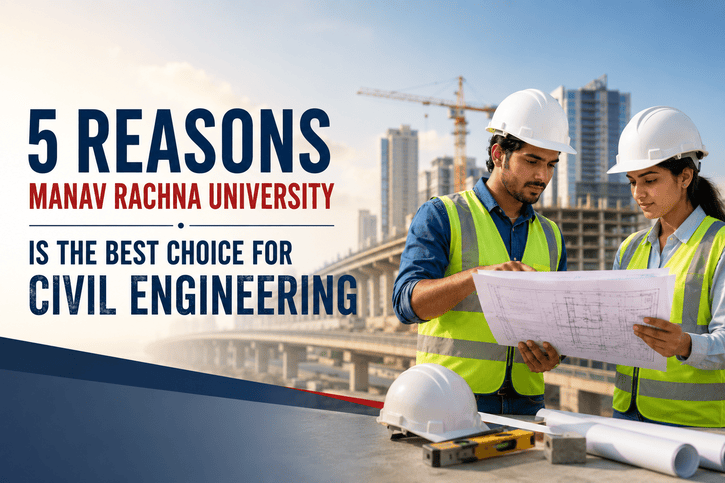
5 Reasons Manav Rachna University is the Best Choice for Civil Engineering
29 Jun 2026
At Manav Rachna University, Civil Engineering education with a focus on practical oriented learning, contemporary infrastructure, and industry exposure provides a strong technical foundation that equips students for real engineering instead of just examinations.
The field of Civil Engineering has changed. Smart cities and green buildings, digital construction tools and sustainable infrastructure are redefining what we expect of engineers, and what they should be able to do. Civil engineers now are integrating, designing, planning and managing the complex and diverse infrastructure for safety, efficiency and long-term impact.
Finding the right civil engineering college is an integral part of this preparation. Beyond the degree itself, students should be looking at labs, live projects, faculty support, internships, and placement assistance, everything that turns classroom learning into career readiness.
What Makes a Good Civil Engineering College in the Changing Industry of Today?
A good civil engineering college is the one which prepares the students for the class room learning as well as the real projects.
Hands-On Learning Experiences: Labs, projects, workshops, surveys, design work and field-based learning provide civil engineering students with hands-on experience to relate theory to real work.
Industry Relevant Curriculum: Curriculum should be in harmony with the current practices for construction and infrastructure. In addition to the core concepts, it is worth noting sustainability, smart infrastructure, design software and project execution.
Infrastructure and Technology: Modern labs, tools, and software combined allow students to learn a lot about materials, structures, soil, construction methods, and planning techniques.
Career Preparation: Through a combination of internships, mentorship, industry exposure, and communication skills development, students are guided from the academic world to the real world of work.
Top 5 Reasons Why Manav Rachna University Is the Best for Civil Engineering
Any good industry that is outstanding for a particular field of study is one that is strong in innovation, hands-on learning, industry exposure and tapping rewarding career opportunities for students. There is no exception of Manav Rachna.
1. Industry Oriented Civil Engineering Education
Our civil engineering curriculum is designed around the practical demands of the infrastructure and construction sector, not just core concepts, but how they're applied in the field. The civil engineering curriculum is tailored to develop the fundamental concepts and the practical requirements of the infrastructure and construction sector. The most important areas of study are structural engineering, choice of construction materials, transportation, environmental engineering, geotechnical engineering and project planning.
2. Hands-On Learning and Cutting Edge Infrastructure
In Civil engineering, one can test and observe and apply the concepts in real time and it becomes easier to understand. We support this through well-equipped engineering labs, hands-on experiments, software exposure, and project-based learning, so students can see engineering principles working in real conditions, not just read about them.
3. Exposure to New Areas of Civil Engineering
The future of civil engineering is all about sustainable building, smart infrastructure, green buildings, data-driven planning and advanced construction practices. So students who are coming into this field today can do better if they have early exposure to these core areas in their academic journey.
Our students get early exposure to these emerging areas, building an understanding of tech-driven engineering solutions and future-oriented infrastructure that most programs don't cover until much later. This in turn helps them to understand how modern civil engineers are contributing to the shaping of smart cities, sustainable urban development and better public infrastructure.
4. Exposure to Industry, Projects and Skill Development
Civil Engineering education is rooted in exposure to industry. We connect academic learning with professional practice through internships, live projects, industry interactions, and skill-building activities.
Internships & live projects provide students an experience of Site Co-ordination, Team Work, Timelines, Documentation, Safety, Client expectations and Execution challenges. These experiences enable students to experience the realities of the civil engineering profession. The university also puts stress on professional skills. We also put real emphasis on professional skills, communication, presentation, leadership, and teamwork, because civil engineers work across clients, contractors, consultants, and project teams throughout their careers.
5. Career Opportunities and Student Development in All Dimensions
We build career readiness through placement support, mentoring, professional development, and learning opportunities that go beyond what happens in the classroom. Civil Engineering graduates should seek opportunities in construction, infrastructure, real estate, consulting, project management, structural design, transportation, urban planning and environmental engineering. There are also new career paths that are opening up as smart infrastructure and sustainable development are gaining attention.
How Manav Rachna Builds Civil Engineers Ready for the Future
We prepare civil engineers for what's ahead through faculty mentorship, research exposure, innovation-driven learning, and a collaborative academic environment that encourages both technical and personal growth.
Faculty support helps students to learn technical subjects, to choose projects and to plan their academic direction. There are research and innovation opportunities to pursue ideas in construction, sustainability, smart infrastructure and materials. Students also learn to work with others and develop a better project mentality through collaborative learning.
Students get a wider learning through academic activities, workshops, technical events and extra-curricular participation. Why is this so crucial? Civil Engineers need to have technical ability, teamwork and a responsible understanding of how infrastructure impacts society.
Scope of Civil Engineering in Career
Civil Engineering offers excellent career opportunities. Infrastructure development supports housing, transportation, water systems, urban development and economic growth. Graduates may work with construction companies, infrastructure firms, government departments, property developers and design consultancies.
Traditional Career Paths
Structural Engineering
Construction Management
Site Engineering
Quantity Surveying
Transportation Engineering
Project Coordination
Engineering Consultancy
Emerging Opportunities
Urban Development
Sustainable Infrastructure
Smart City Projects
Green Buildings
Environmental Engineering
Water Management
Digital Construction
By developing knowledge of modern engineering tools and sustainable practices, students can build successful careers in both traditional and future-focused areas of Civil Engineering.
Why Students Need to Choose the Right Educational Institution for Engineering
The decision of selecting the right engineering college is a long term decision. It impacts the technical base, confidence, peer learning, exposure to industry and career direction of a student.
For Civil Engineering specifically, a field that directly shapes homes, roads, cities, and public infrastructure, being at the right educational institution makes a difference that shows up long after graduation. Students looking for the best college for civil engineering should prioritise places where they can learn by doing, not just by listening.
Conclusion
An excellent holistic ambience is offered to students at Manav Rachna University to create a fruitful career path in Civil Engineering by integrating practical approach, modern infrastructure, industry-oriented education and real career preparation.
As the construction industry moves toward sustainability, smart infrastructure, and technology-led development, students need a civil engineering college that equips them for both what the industry needs now and where it's heading next. That's what we've built our program around.
Frequently Asked Questions
1. Is Civil Engineering a good career choice in 2026?
Yes. Civil engineering job demand is expanding across infrastructure development, smart cities, sustainable construction and urban planning. Trained civil engineers continue to be the most in-demand graduates in the country India is making massive infrastructure investments.
2. What practical exposure do Civil Engineering students receive at Manav Rachna?
Our students experience a blend of engineering labs, industry internships, live projects and site-learning, thereby ensuring a smooth transition from campus to professional world, and not a hard shift.
3. Can Civil Engineering graduates work in emerging fields like smart cities and sustainable infrastructure?
Absolutely. These are among the fastest-growing areas in the field right now. At Manav Rachna, we build early exposure to sustainable construction, digital planning tools, and smart infrastructure into the curriculum, so students are already familiar with these areas before they graduate.
4. What makes Manav Rachna a strong choice over other civil engineering colleges?
It comes down to what happens alongside the degree - modern labs, faculty mentorship, industry-connected internships, and dedicated placement support. We focus on building engineers who are technically strong and professionally ready, not just degree holders.


.png)














 ADDRESS