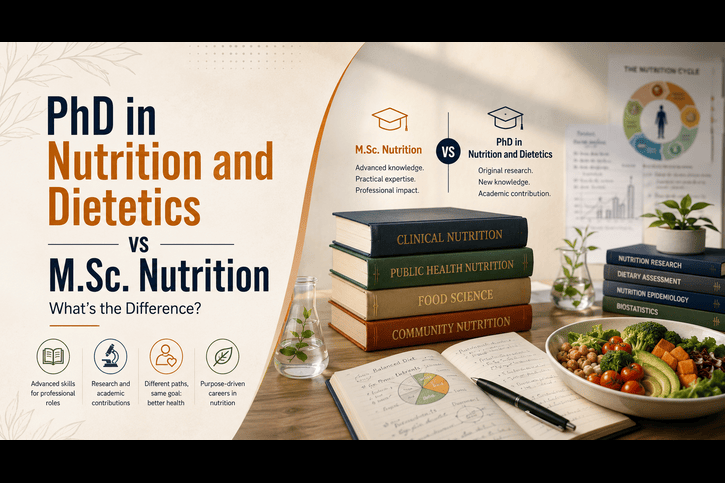
PhD in Nutrition and Dietetics vs M.Sc. Nutrition - What
30 Jun 2026
An M.Sc. in Nutrition builds advanced skills for professional roles, while a PhD focuses on research and academic contributions. Manav Rachna offers pathways for both, tailored entirely to your career goals.
There is a consistent increase in demand for skilled nutrition professionals. Already there are ample opportunities, and with increasing public awareness of wellness and prevention, it is one of the more purpose-driven ways to build a successful career. Community health programmes and food industry alike along with research institutions are in need of nutrition professionals.
One question is commonly posed by postgraduate students in nutrition. Do you go back to the workforce after a master's or go to doctorates? This article explains the differences between the two.
At Manav Rachna, we offer professional pathways to help you if you want to progress to a clinical career after a master's or go on in research with a Ph.D.
Understanding the Academic Journey: Where do M.Sc. and PhD fit?
Well, the choice between pursuing a doctorate or going for a master’s degree often depends on the person’s long-term career aspirations.
After completing an undergraduate degree in nutrition, food science, or a related field, students typically move in one of two directions:
What do students typically pursue after Graduation?
Many of those completing an undergraduate degree in nutrition, food science, dietetics or a related discipline will wish to expand their knowledge and, thereby, the opportunity for their career advancement.
Some may wish to complete a masters in nutrition and dietetics for advanced professional knowledge, while others may ultimately complete doctoral research to make a contribution to the field.
Purpose of a Master’s Degree
A masters in nutrition is designed to:
Build advanced subject knowledge
Strengthen practical and clinical skills
Develop expertise in nutrition planning and assessment
Prepare students for professional roles in the healthcare and nutrition sectors
Purpose of Doctoral Research
A PhD in nutrition focuses on:
Conducting original research
Generating new scientific knowledge
Addressing complex health and nutrition challenges
Contributing to academic and policy development
M.Sc. Nutrition vs PhD in Nutrition and Dietetics: Key Differences
Understanding the differences between these two degrees helps you make a choice that genuinely aligns with your future plans.
Factor
M.Sc. Nutrition
PhD in Nutrition and Dietetics
Programme Objective
Advanced academic and professional training; develops applied nutrition expertise and prepares students for healthcare roles
Research-based education focused on generating new knowledge and academic or scientific specialisation
Duration
Typically 2 years
Longer duration; varies based on research scope and supervision
Study Structure
Structured coursework with practical learning and a dissertation component
Predominantly independent research under academic supervision
Learning Focus
Coursework-heavy with clinical and applied learning; practical assignments and projects
Research-driven; scientific enquiry, extensive investigation, and publication-oriented work
Assessment Methods
Examinations, case studies, projects, and practical evaluations
Research progress, dissertation quality, publications, and thesis defence
Specialisation
Broad specialisation across nutrition and dietetics
Deeper expertise in a specific area, Clinical Nutrition, Public Health Nutrition, Sports Nutrition, Pediatric Nutrition, Food Science, or Community Nutrition
Research, Clinical Practice, or Industry: Which Path Aligns With Your Goals?
Well, the right choice for you will depend on the kind of career you are envisioning for yourself.
Students Interested in Clinical Nutrition
If you want to go on and work directly with patients, you can benefit from pursuing a masters in nutrition and dietetics.
Some common career settings on this route are as follows:
Hospitals
Clinics
Wellness centres
Healthcare organizations
Students Interested in Research and Innovation
If you’re somebody who is interested scientific discovery will find a PhD in nutrition much more suitable:
Some of the research opportunities that you will get are as follows:
Nutritional interventions
Disease prevention studies
Food innovation
Public health research
Students Interested in Public Health and Community Nutrition
When it comes to public health, be assured that both routes will lead to a career in public health:
If you graduate and become a professional, you can contribute in the following:
Community nutrition programs
Government health initiatives
Nutrition awareness campaigns
International health organizations
Students Interested in Teaching and Academia
Students who are seeking long-term careers in academia can profit from obtaining a PhD in nutrition and dietetics, especially if they are to hold higher level teaching and research postulations.
Difference in Career Opportunities after M.Sc. and PhD.
The depth of your course and its education often play a pivotal role in determining the career opportunities you get after a course.
So, let’s break it down for both options at hand.
Career Opportunities after a Master’s Degree
Graduates with a masters in nutrition can pursue opportunities in:
In Clinical Practice:
You can go on to become a clinical nutritionist
You can become a dietitian
You can also become a nutritional consultant
Roles in Healthcare and Wellness:
You can become a health coach
Wellness advisor is an appealing role in the field
You can also take up the role of a nutrition program coordinator
In Food and Nutrition Industries:
You can become a product development associate
The role of a nutrition specialist is available
You can also become a food quality professional
In Public Health Initiatives:
In the public health domain, you can become a community nutrition officer.
You can also become a programme manager or a health promotion specialist.
Career Opportunities After a PhD
Graduates who complete a PhD in nutrition typically move into roles where research credentials and specialised expertise matter most:
In Academic and University Careers:
Faculty member or academic researcher
Department lead at a university or research institution
In Research Institutions:
Researcher at government health or public health bodies
Scientist at independent research organisations
In Policy and Advisory Roles:
Nutrition policy advisor
Consultant with government agencies or international health organisations
In Leadership Positions:
Head of clinical nutrition programs or research divisions
Senior leadership roles in health and nutrition sectors
Skills and Competencies Developed at Each Level
These two programs provide different but complementary skill sets, and it is helpful to know this difference in deciding which one is right for you.
Skills Developed During an M.Sc.
Students pursuing a masters in dietetics or nutrition build strong applied skills that translate directly into clinical and industry practice:
Applied nutrition knowledge across clinical and community settings
Clinical assessment and patient-facing nutrition planning
Program planning and health promotion skills
Practical skills in nutritional counselling and dietary evaluation
Skills Developed During a PhD
Doctoral research builds a different kind of expertise, one centered on generating and communicating new knowledge:
Research methodology and scientific investigation
Academic and scientific writing for publication
Advanced data analysis and interpretation
Leadership in research projects and collaborative scientific work
Is a PhD Necessary for a Successful Career in Nutrition?
After reading through this blog, you must be wondering if a PhD is necessary for a successful career in nutrition.
Well, the answer to this is not that simple. Let’s break it down.
Situations Where a Master's Degree May Be Sufficient
For many careers, a master's qualification provides the knowledge and skills required for professional growth.
Examples include:
Clinical nutrition
Wellness consulting
Public health programs
Food industry roles
When Doctoral Education Adds Value
A PhD may be particularly valuable for students interested in:
Academic careers
Advanced research
Scientific leadership
Policy development
Conclusion
The core difference between an M.Sc. and a PhD in Nutrition and Dietetics comes down to purpose. A master's program builds advanced knowledge and prepares students for professional practice. A PhD goes further, into research, specialisation, and creating new knowledge in the field.
There’s no better overall choice, it depends on the direction you want your career to go in, your willingness to engage in research and how much time you want to devote to your degree. Manav Rachna provides both and our professors can guide you through what may be the best fit for you.
FAQs
1. Is a PhD in Nutrition and Dietetics required for teaching at the university level?
In general, yes. Universities consider a PhD a requirement for science faculty positions and academia-based research roles. However, if you are intending to lecture in diploma or vocational nutrition programmes, the master's may suffice depending upon the university.
2. What is the difference between clinical nutrition careers and nutrition research careers?
Clinical nutrition is a term used to describe careers where you will work with patients to assess biological and lifestyle factors and design and deliver nutrition plans. Nutrition research is a term used to describe careers where you will conduct nutritional studies and research to generate new knowledge and then contribute to academic and policy work.
3. How do students decide whether to continue from a master's degree to a PhD?
If you enjoy doing research, statistical data work and writing in the academic sense, then a PhD is highly recommended. However, if your end goals are towards pursuing clinical practice, the food industry and public health service delivery, then a master's is typically sufficient.


.png)














 ADDRESS