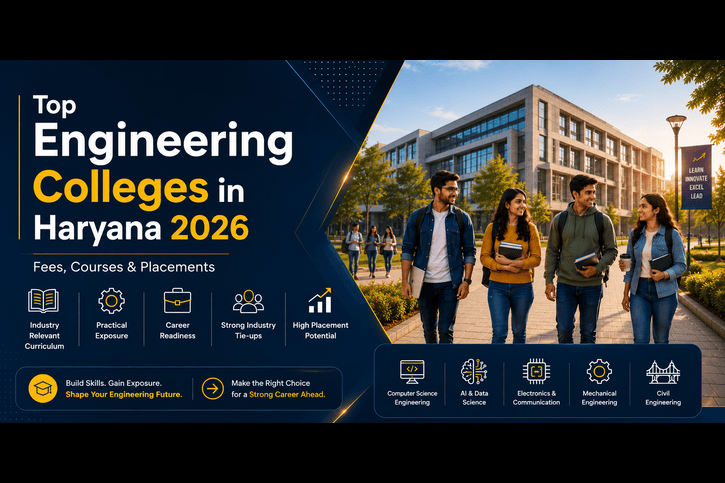
Top Engineering Colleges in Haryana 2026: Fees, Courses & Placements
22 Jun 2026
Choosing the right engineering college in Haryana comes down to academic quality, course offerings, infrastructure, industry exposure, and placement support, not rankings alone. At Manav Rachna, our programs are built around exactly these priorities.
Introduction
Choosing the place to spend the next four years of your engineering course is a huge step. Haryana has quickly become a huge education hub and is a magnet for aspirants of engineering from every part of the country; the way students assess a course or a college has also evolved. A simple ranking of colleges or proximity to home will no longer do the trick.
If you're building toward a secure career, the learning environment around you matters just as much as the degree itself. This guide covers what to actually look for - programs, course fees, and placement outcomes, along with a few factors that often get overlooked.
What Should Students Look for in an Engineering College in 2026?
So, before giving you the list of college names you might be considering, let us first look at what makes a good decision. There are three pillars of a good engineering course:
Industry-Relevant Curriculum: The tech industry jumps from ground to sky overnight and you don’t want your syllabus to stay lurking in the past. A quality technology-based education means you are studying on the latest software and tools and you are an instant attraction for the companies of the future.
Practical Exposure: Reading about engines or code is one thing. Building them is another. You’d want a college that moves from theory to hands on via sophisticated laboratories, interesting projects and must-do corporate internships.
Career Readiness: A good college helps you settle down in the working world long before graduation. Try to look for schools that offer placement support that focuses on skill-mart setting, skill refining workshops and regular interaction with corporates.
Popular Engineering Courses Students Can Explore in Haryana
The strongest colleges offer programs aligned with where the job market is heading. Here's what to look for :
Computer Science Engineering: Kind of the powerhouse of today, centered on coding, building software, and thinking through system design.
Artificial Intelligence and Data Science: It’s a big growth path, made to show you how to create smarter machines and also interpret enormous amounts of digital information.
Electronics and Communication Engineering: This one is the branch that handles the actual hardware behind mobile networks, smart gadgets, and IoT (Internet of Things).
Mechanical Engineering: A classic and flexible area, it leans into robotics, automotive design, and modern manufacturing.
Civil Engineering: Best if you want to plan smart cities, large-scale infrastructure, and sustainable green buildings.
Emerging Engineering Specialisations: Go for the newer, cutting edge kind of niches, like cybersecurity, biotechnology, and advanced robotics, or similar directions.
Top Engineering Colleges in Haryana for 2026
Here's a quick comparison of some of the well-regarded engineering colleges in Haryana, before we get into what's actually worth digging deeper on:
College
Location
Popular Courses
Key Highlights
Manav Rachna (MRIIRS & MRU)
Faridabad
B.Tech CSE, AI & Data Science, ECE, Mechanical, Civil
NAAC A++ accredited, strong industry tie-ups, modern labs, active placement support
At Manav Rachna, our engineering programs are built around the specialisations students are increasingly choosing - AI, data science, and core branches like mechanical and civil, supported by labs and industry partnerships designed to keep pace with where these fields are heading.
Understanding Engineering Fees and Return on Investment
Fees are an important factor, but the number alone doesn't tell you much. What matters more is the value behind that fee, what's actually being delivered for it.
Factors Influencing Fee Structure: Tuition is usually driven by the specific type of program, the quality of the campus infrastructure, available student facilities, and the level of academic resources provided. Tuition is usually shaped by the type of program, the quality of campus infrastructure, available student facilities, and the academic resources provided, these are the real drivers behind fee differences.
Evaluating ROI (Return on Investment): A slightly higher fee might be worth it, if the outcomes are better. You can measure a college’s ROI by checking historical placement outcomes, the depth of skill development they provide, and the overall career opportunities it opens up for you.
Placement Opportunities After Engineering
At the end of the day, the goal is a strong career, and keeping an eye on how hiring trends are shifting makes it easier to choose the right direction.
Technology Sector: Both established tech companies and startups consistently hire software developers and cloud engineers.
Manufacturing: Modern factories run on automation and smart production systems, which keeps demand steady for engineers in this space.
Infrastructure: Right now, there’s a real surge in demand for folks who can steer sustainable construction initiatives.
Research and Innovation: This one is ideal for forward thinkers who want to invent brand new technologies.
And to stand out in any of these areas, you’ll need the right mix of abilities, not just one thing. The skills that boost your placement readiness include solid technical strengths, sharp problem solving power, and also excellent communication skills, even in messy situations.
Why Private Engineering Colleges Are Becoming a Preferred Choice
More students than ever are choosing private engineering colleges over traditional ones, and the reasons are fairly clear. Private colleges tend to bring in modern, industry-style infrastructure and maintain strong corporate connections. That usually translates into an updated syllabus, stronger hands-on learning, and better support for students interested in innovation or entrepreneurship.
How to Shortlist the Right Engineering College in Haryana?
If you are ready to narrow things down, make your search less confusing with these steps:
Check Accreditation and Academic Quality: First, confirm the college is officially recognized.
Compare Courses and Specialisations: Try matching the exact program with your long-term career plan.
Review Industry Exposure: Look for signs of internships, industry projects, and corporate training programs.
Evaluate Placement Support: Go through their previous salary ranges, and also the recruiting organizations.
Consider Campus Environment: Choose a campus where you can actually breathe and grow comfortably for four years.
Conclusion
There's more than one factor to consider while choosing an engineering college. It's the courses, the fees, the infrastructure and most importantly the potential career growth. It doesn't just matter what looks good in the instant way; rather, what potential grades it can offer in the future.
If you’re looking for engineering admissions in 2026, we strongly recommend going through our guide. At Manav Rachna, we have designed our courses keeping these dynamics in view and welcome you to join us confidently.
Frequently Asked Questions
1. How do I choose the right engineering college in Haryana, like really pick it?
You should evaluate the college’s academic quality in a systematic way, and check the exact courses they offer, their campus infrastructure, and also how much practical, industry exposure you actually get. Don’t skip the placement support strength either, because that part is basically where everything lands.
2. Are private engineering colleges in Haryana a good option for career growth?
Honestly yes, they are quite recommended. Most of the time they bring modern infrastructure, good corporate connections, an updated curriculum, and solid practical learning opportunities. They also tend to have dedicated support for innovation and entrepreneurship, which helps a lot for future direction.
3. What factors should students consider apart from engineering college fees?
Beyond tuition alone, students should look at the real return on investment. That means reviewing placement outcomes, the depth of skill development they provide, and the long-term career opportunities the institute can realistically enable for you.


.png)
















 ADDRESS