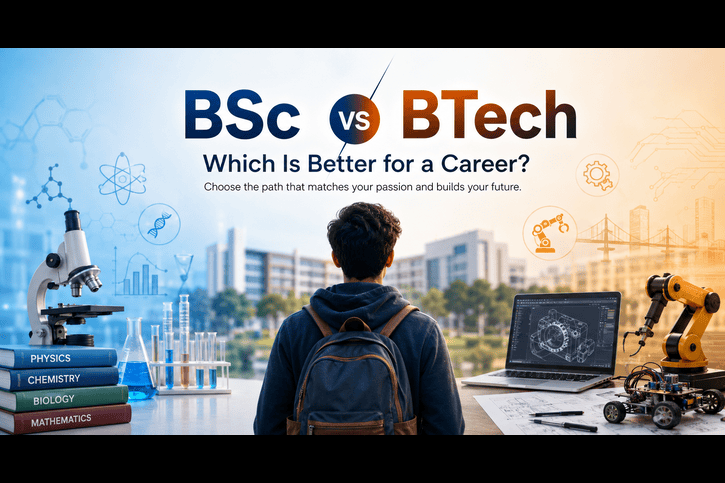
Neither BSc nor B.Tech is inherently better; the right choice depends on your career goals and learning style. Manav Rachna offers top-tier science and technology programs to build a focused, career-ready foundation either way.
Picking the right track after 12th is one of the most significant academic decisions that you. Many get stuck at this point, especially when it comes to science-focussed and engineering-focussed options like BSc and BTech.
Although both the paths can be life-changing for your life, the learning style, skills, and the type of professional you become vary, and getting the idea about these before deciding will make you have an easier time.
Understanding BSc and B.Tech: What Do These Degrees Focus On?
First of all, you should try to understand the primary focus of each of these programmes before you make the big choice.
BSc Degree Focus
Primarily, when you pursue a BSc degree, you build a strong foundation in scientific concepts and gain a robust theoretical understanding of science.
Here, your study will focus on:
Core scientific principles
Research methodologies
Data analysis
Subject specialization
Scientific problem-solving
Key Benefits of a BSc Degree
Strong conceptual understanding
Research-oriented learning
Analytical skill development
Opportunities for academic specialization
B.Tech Course Focus
On the other hand, the primary focus of the B.Tech course is the application of scientific and mathematical concepts in order to solve real-world problems through technology and engineering.
Here, you will learn:
Core principles of engineering
Application of technology
Product development
Technical design
Industry-specific problem-solving skills
Key Benefits of a B.Tech Degree
You gain a practical approach to learning
The curriculum is relevant to today’s industries
Project-based education
You gain strong technology exposure
BSc vs B.Tech Course Difference: Key Factors Students Should Compare
To compare these two courses really well, it’s useful to think about the factors that directly shape the career paths you can take.
Factor
BSc
B.Tech
Learning Approach
Theory-oriented, with a strong emphasis on scientific research, conceptual learning, and science.
Application-oriented, with a strong emphasis on engineering, technology and problem solving.
Skill Development
Builds scientific thinking, research capabilities, analytical reasoning, and subject expertise.
Laboratory work, research projects, scientific research, and scientific research projects.
Engineering labs, technology projects, industry products, and product development projects.
Career Direction
Scientific research careers, scientific research roles, research and research positions.
Engineering careers, product development and technology careers, industry roles.
Career Opportunities after BSc and B.Tech
Career Paths after BSc
A BSc degree can open doors to several professional opportunities.
1. Research Roles
Students may pursue careers in:
Scientific research
Research assistance
Laboratory research projects
2. Data and Analytics Opportunities
Many industries require professionals who can analyze and interpret data.
Potential roles include:
Data Analyst
Research Analyst
Business Intelligence Associate
3. Laboratory and Scientific Careers
Opportunities exist in:
Testing laboratories
Scientific organizations
Healthcare research facilities
4. Higher Education Pathways
Many students choose to continue with:
MSc programmes
Research-based studies
Specialized certifications
Career Paths after B.Tech
A B.Tech course often leads directly to industry-oriented roles.
1. Engineering Roles
Common opportunities include:
Software Engineer
Mechanical Engineer
Civil Engineer
Electronics Engineer
2. Technology Careers
Graduates may work as:
Software Developer
Systems Engineer
Cloud Associate
Technology Consultant
3. Product and Innovation Roles
Roles may include:
Product Engineer
Technical Specialist
Innovation Associate
4. Industry-Focused Opportunities
B.Tech graduates often find opportunities across:
Technology companies
Manufacturing firms
Infrastructure organizations
Engineering consultancies
Which Industries Hire BSc and B.Tech Graduates?
The industries available to graduates depend largely on their specialization.
Technology and IT
Both BSc and B.Tech graduates can find opportunities in:
Software companies
IT services firms
Technology startups
Digital transformation projects
Healthcare and Life Sciences
Particularly relevant for BSc graduates specializing in life sciences.
Potential sectors include:
Biotechnology
Healthcare research
Pharmaceuticals
Clinical research
Research and Development
Research-driven organizations recruit graduates from both streams depending on specialization.
Manufacturing and Infrastructure
These sectors traditionally hire large numbers of engineering graduates.
Roles include:
Production management
Quality assurance
Technical operations
Infrastructure development
Emerging Technology Fields
Rapidly growing areas include:
Artificial Intelligence
Machine Learning
Data Science
Cybersecurity
Robotics
Cloud Computing
Career opportunities in these fields often depend more on skills and specialization than the degree title alone.
Skills That Matter More Than the Degree Name
Beyond the degree, employers increasingly care about what you can do, not just your degree name.
Technical Skills
BTech graduates should have the aptitude, aptitude for programming projects and tools for the specific discipline. BSc graduates should have strong domain expertise and be comfortable working with data and research methods.
Professional Skills
Problem solving, clear communication, and being flexible are as vital as general technical knowledge, these are what enable a graduate from either stream to easily transition to real work environment.
Industry Readiness
Your projects, internships, and practical exposure during your degree course carries more weightage than the degree title itself. A project-experienced BSc graduate is likely to have comparable employability prospects as a project-experienced B.Tech graduate.
How to Choose Between BSc and B.Tech Based on Career Goals?
Students should base their decision on long-term interests rather than trends.
Choose BSc If:
You should consider a BSc degree if you:
Enjoy science subjects
Like research and analysis
Prefer conceptual learning
Want to specialize in scientific fields
Are interested in higher studies and research
Choose B.Tech If:
A B.Tech course may be a better fit if you:
Enjoy solving practical problems
Are interested in technology and engineering
Prefer application-based learning
Want industry-focused technical careers
Like working on projects and innovations
Conclusion
Both BSc and B.Tech can bring in a promising career if they suit your interests and long-term career goals. The better option will be the one you are interested in- scientific or technology-oriented.
The good part about Manav Rachna is that we offer good programs in both streams. So if you choose any course you will be having a strong career-oriented base. So before you decide think of your strengths, your inclination to study and where you see yourself in five years that will really help you in making an informed choice.
Frequently Asked Questions
1. Is B.Tech better than BSc for getting industry-focused jobs?
Not better but different. Even BSc graduates highly specialised and practically inclined are just as competitive as B.Tech when it comes to research, data and life sciences and industry and tech roles.
2. Can a BSc graduate build a successful career in technology fields?
Yes. Having a BSc doesn't limit you as much as the skills, like data, analysis, programming or some niche scientific area, you can learn within the degree.
3. Should students choose BSc or B.Tech based on salary expectations alone?
Don't base your choice solely on salary. Long-term goals, what you're good at and what interests you are likely to be more important factors for long-term satisfaction and overall career development than your starting salary.


.png)













 ADDRESS